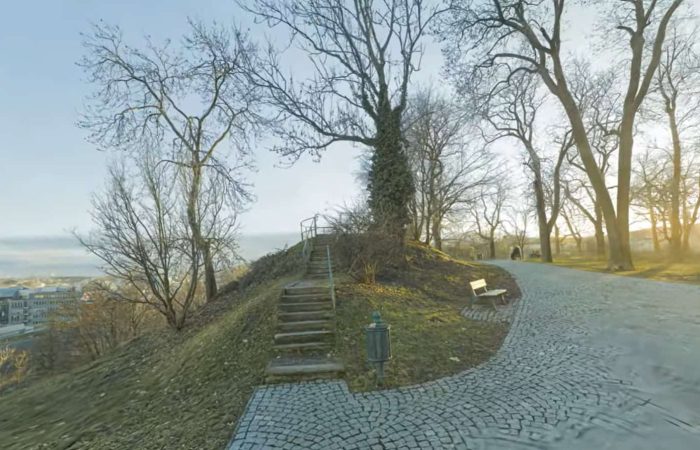
Join us for a Q&A with Mosaic’s Lead Computer Vision Engineer as we investigate the ways in which Gaussian Splats are the rising celebrities of 3D renderings.
This week, we found a moment to have a Q&A about Gaussian Splats with Ilia Shipachev, our Lead Computer Vision Engineer. Ilia’s been on the Mosaic team for over 4 years and leads custom integrations and postprocessing software for our clients. This new technology is taking the industry by storm, so we wanted to get an expert opinion on what Gaussian Splats are capable of and where they’re headed next.
Why will Gaussian Splatting solutions potentially replace panoramic capture platforms like Matterport in the next 5-10 years?
The indoor and handheld panoramic image market has likely reached its technological peak, while Gaussian Splatting (GSplats, 3DGS) offers fundamental advantages that will drive market disruption for several reasons. These include:
Device and Capture Flexibility
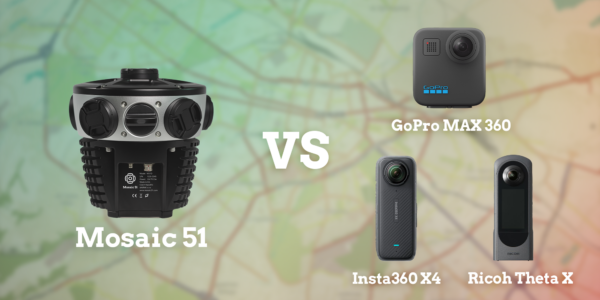
Unlike panoramic systems that require specialized cameras with multiple synchronized sensors positioned close together to avoid parallax artifacts, GSplats can be created with any standard camera – from smartphones to drones.
Recent research demonstrates that GSplats excel at capturing thin geometry, reflective surfaces, and traditionally difficult subjects, eliminating the need for perfect sensor synchronization or specific camera configurations. Nevertheless, sensor synchronization provides increased robustness to the reconstruction process, decreasing the amount of parameters to be optimized and reconstructing camera views not achievable without such constraints, like cameras looking up.
Ecosystem and Processing Advantages
The panoramic imaging ecosystem remains surprisingly closed, with virtually no open-source GPU-accelerated panorama stitching tools available. In contrast, GSplats benefit from a thriving open-source ecosystem.
Mature SfM tools, such as COLMAP, handle camera calibration and sparse point cloud generation, while specialized tools like Nerfstudio provide comprehensive frameworks for neural rendering and Gaussian Splatting workflows. Interactive editing tools like GaussianBrush enable direct manipulation of splat scenes, and platforms like Polycam and Luma AI have made creation accessible to consumers.
This creates a healthier, more innovative ecosystem with rapid development cycles. Processing times are dramatically improving, too. Recent satellite photogrammetry implementations achieve state-of-the-art performance in just minutes compared to the day-long optimization that older methods require.
Market Validation
Major industry players are already investing heavily in this area. Esri announced that ArcGIS Pro will add Gaussian Splatting as a new layer type in its November 2025 3.6 release. This alone signals enterprise adoption for everything from infrastructure digital twins to healthcare mapping applications. DJI Terra‘s latest update also now includes Gaussian Splatting support for drone-based reality capture.
What makes Gaussian Splatting superior to panoramic images for navigation and interaction in 3D spaces?
The limitations of panoramic capture become clear when compared to the native 3D capabilities of Gaussian Splatting. This is especially true regarding their:
True 3D Interactivity
GSplats provide native 3D structures that enable volume measurements, height calculations, and dynamic object removal (such as walking people). Unlike flat panoramic projections, GSplats represent scenes using 3D Gaussian functions with full geometric information. They allow for genuine 3D interaction and analysis. Object recognition and selection can leverage the complete 3D data rather than working with 2D projections.
Smooth Navigation
Panoramic captures lock users to specific viewpoints, creating a clunky “cell-to-cell” navigation experience reminiscent of early video games. GSplats enable smooth, continuous transitions between any viewpoints in the captured space. They provide a fundamentally more natural experience.
View-Dependent Effects
GSplats can capture and reproduce complex lighting effects, such as reflections, which are impossible with traditional panoramic stitching, which assumes a static appearance from all viewpoints. This capability is crucial for accurately representing real-world materials and lighting conditions.
Why are Gaussian Splats better suited for real-world data than traditional textured mesh representations?
The textured mesh paradigm, while successful in game engines with carefully crafted assets, fails to scale efficiently for real-world capture. Gaussian Splats beat traditional textured mesh for their:
Complexity Handling
Real-world scenes don’t follow the game industry’s model of repeatable geometry with tiled textures. Each surface in reality is unique. This requires photogrammetry to generate unique polygons and unique texture maps for every surface. GSplats represent scenes more efficiently using 3D Gaussians that naturally handle complex geometry without the need for explicit mesh topology.
Thin Structure Representation
Textured meshes struggle with thin structures like wires, leaves, or hair. These things are very common in real-world scenes. They require either extremely dense mesh tessellation (computationally expensive) or alpha-masked textures (visually poor from many angles). GSplats excel at reproducing fine, complex details that photogrammetry often fails to capture.
Reflective and Transparent Materials
GSplats can accommodate view-dependent appearance changes, capturing reflectivity and transparency that static textured meshes cannot represent. The technique supports the rendering of complex effects, such as reflections, which are critical for the realistic representation of glass, water, and metallic surfaces commonly found in real environments.
Performance and Real-time Rendering
While mesh rendering is hardware-accelerated, the overhead of managing thousands of unique textures for real-world scenes creates bottlenecks. GSplats achieve real-time rendering at ≥100 FPS at 1080p resolution. Recent volumetric capture systems demonstrate the advantages of Gaussian splatting for real-time visualization, even on web browsers and VR headsets.
Standardization Momentum
The industry is rapidly converging on GSplats. Major companies, including Meta, NVIDIA, Microsoft, and Niantic, are collaborating on standardization efforts through the Metaverse Standards Forum, with discussions centered on integrating GSplats into established formats such as glTF and 3D Tiles.
To be continued…
We are sure this won’t be the last time we hear about Gaussian Splats! If you can’t get enough of them, check out our other blog, Points, Triangles, Blobs, and Ellipsoids: What Exactly are Gaussian Splats? There, our CEO and co-Founder breaks down this complex topic for casual conversation.