What are industry experts saying about 2026?
To build a great mobile mapping system, you need to know the new directions the industry is heading towards and the challenges your customers face. At Intergeo 2025, Mosaic CEO Jeffrey Martin spoke with leaders from across the geospatial world to get boots-on-the-ground insights for the coming year. He heard from GIS superstars, reality capture experts, and field practitioners operating worldwide.
From the many interviews we had over the week, we parsed out the top geospatial trends to keep an eye on in 2026.
1. Gaussian Splatting is here to stay
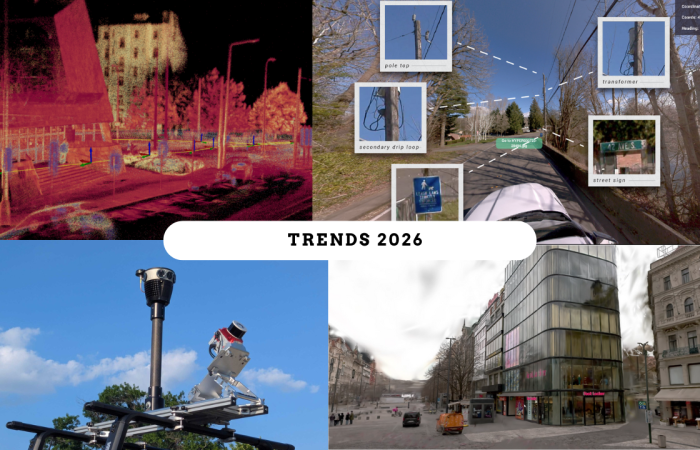
One of the year’s biggest breakthroughs in geospatial visualization was the rapid adoption of Gaussian Splatting. It’s becoming a mainstream visualization layer that connects the precision of point clouds with the expressiveness of imagery. This technological shift makes it easier to explore, share, and interact with complex environments.
“[Gaussian Splatting] is starting to be a lot more recognized as an actual medium for both software and hardware companies. People are getting really excited about being able to capture the world in super lifelike 3D.”
– Michael Rubloff, Founder and Editing Manager at Radiance Fields
We are seeing Gaussian Splatting natively supported in major GIS tools such as ArcGIS, which is driving adoption into more professional workflows. Fidelity, realism, and rendering improvements are also coming fast. Coupling these with shrinking file sizes has led to exponential growth in GS interest and capability.
Want to learn more about Gaussian Splats? Check out Points, Triangles, Blobs, and Ellipsoids: What Exactly are Gaussian Splats?
2. Semantic awareness and AI are becoming requirements
Gone are the days of just looking at a 3D scene. Today’s geospatial professionals want built-in tools that help them understand what is in it: objects, signs, assets, defects, etc.
Semantic understanding of captured environments using AI has already been integrated into many major software programs. It is no longer experimental, and large companies are relying on it to automate classification and reduce manual work.
We are also seeing specialized AI tools for industry-specific needs, such as in the railway and forestry industries. This highlights the value of having deep knowledge of a niche industry and meeting their project needs before another software company does it first.
3. 360° imagery continues to captivate
Of course, we may be a bit biased on this one, but for many who stopped by our booth, 360° imagery has become a core component of their business.
360° imagery is accelerating decision-making and providing context that is hard to get from LiDAR or aerial imagery alone. This is especially true for translating results to laypersons or stakeholders of varying levels of skill. It is quickly becoming a standard part of the data collection process, particularly for those in asset management, cadastral mapping, and surveying.
To learn more about 360° imagery’s unique role in data collection, read A Job Only Street View Can Do: An Academic Case Study of Hurricane Ian.
4. Accuracy matters, but so does usability
Surveyors and GIS professionals still care about precision, but workflow efficiency is equally important. There are a very few use cases that require sub-centimeter accuracy, so many are willing to choose tools that offer high accuracy quickly, rather than perfect accuracy slowly, especially when it cuts costs and speeds up the decision-making process. Accuracy debates are shifting:
- Gaussian Splatting isn’t yet the authority for measurements, but in some implementations, it supports measurements when backed by photogrammetric context.
- 360° imagery systems, like Mosaic cameras and MLS systems, deliver usable, high‑resolution visuals consistent enough for most real‑world tasks.
- Integrated systems (360 + LiDAR + GNSS) that balance resolution with practicality.
5. Modularity and interoperability are not optional anymore
Rather than monolithic hardware or locked workflows, users want modular stacks. They want to plug in new components, disable certain features, and combine tools based on a specific project’s needs. Experts praised systems that:
- Support mixed sensors,
- Output open-formatted data that can be read by external tools,
- Are flexible enough to future-proof their business against changing data format standards,
- Allow users to keep control of how they process and use data.
This new direction isn’t hardware or software-specific. It reflects industries as a whole. System flexibility will be a core selection criterion as organizations design their processes for greater complexity and longevity.
6. Community‑driven innovation is rising
Technology is evolving fast, often at the edges, and is led by professionals who combine tools in novel ways. Bottom‑up innovation, powered by community knowledge sharing, will be a major driver of practical progress. This trend will continue in 2026 as:
- Field practitioners adapt tools beyond their original use cases,
- Open ecosystems facilitate experimentation, and
- Small developers push creative extensions.
Looking ahead to 2026
The future of geospatial, as we heard repeatedly at Intergeo, is not about one “killer app.” It lies in interwoven systems of capture, interpretation, and action:
- Visualization that feels real (Gaussian Splats),
- Intelligence that understands content (AI and semantics), and
- Data that lasts (open formats and interoperability).
As Arkadiusz Szadkowski, Global Lead for ArcGIS Reality and Reality Mapping, said in our interview:
“Right now, we are only scratching a small percentage of this market with imagery and high-content data. If we can bring that high‑quality imagery and reality mapping to even 10% of the GIS community, this would create a huge demand.”
To see the full Intergeo 2025 interviews and more, head to the Mosaic YouTube channel.