Mobile mapping cameras continue to be the leading tool in the surveying sector. There are some well-known giants on the scene that have been around for some time, and there are some newer contenders on the list of ‘the best mobile mapping cameras’.
In 2021, we introduced a brand-new 360 ° mobile mapping camera, the Mosaic 51. It was the first of its kind to really check off all of the boxes for those in the surveying field – robust, mobile and portable, easy to manage and operate, high resolution, and non-vendor locked.
Mosaic has once again delivered another entrant into the market of mobile mapping cameras, listed below. Read on to learn what makes this one special and if it is able to steal the crown from its slightly more mature brother.
Before we dive into the contenders list, let’s take a quick look at what mobile mapping is and why it is so fundamental for governments, municipalities, logistics companies, and even real estate companies.
What is mobile mapping?
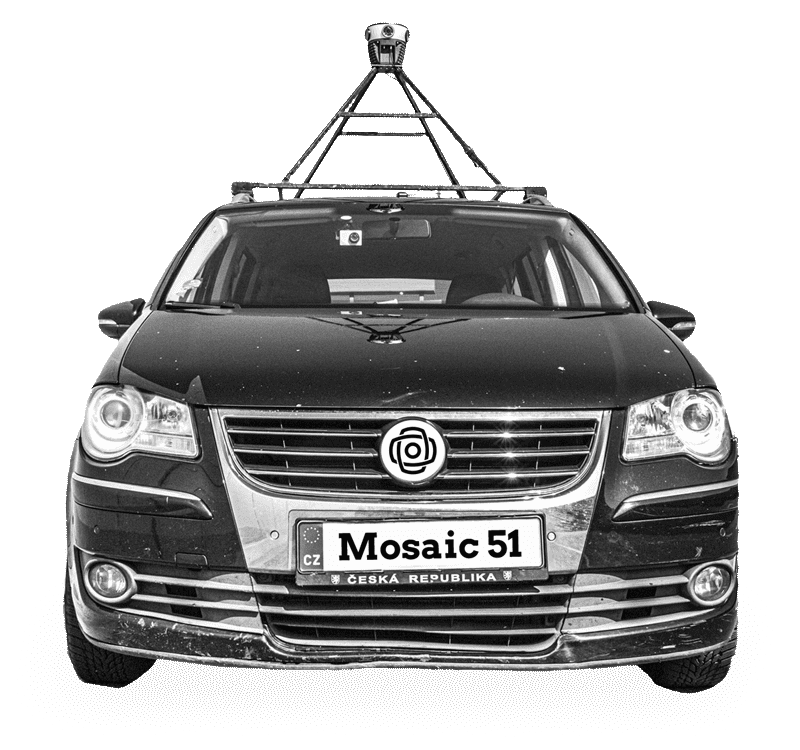
Mobile mapping combines the maneuverability of a vehicle with several technologies for the collection of geospatial data. Some of these technologies include GNSS, LiDAR, radar, laser, and various other systems. They are usually within a camera-like device and mounted onto a mobile platform. Some devices come as a camera and a separate workstation that accompanies the camera within the vehicle. As one study on navigation puts it,
Mobile mapping represents a heterogeneous type of sensor integration consisting of navigation sensors as well as imaging sensors, altogether time synchronized and mounted on a common platform.
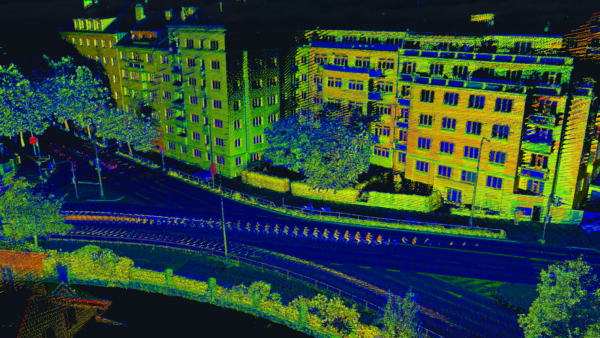
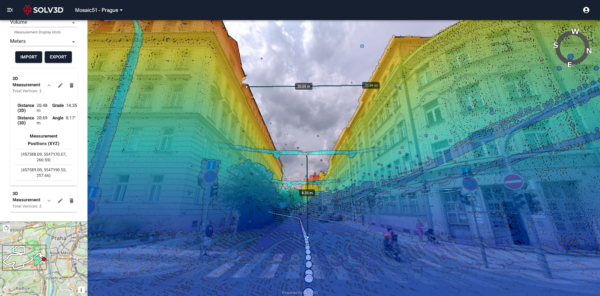
Through the use of mobile mapping, we can obtain digital maps (ones that are accessible on computers and smartphones, allowing the user to interact with them), GIS (geographic information system) data, and georeferenced images and videos. But what does that mean for the average, everyday citizen? How is mobile mapping shaping our lives?
Applications of mobile mapping

Mobile mapping has an incredible array of applications for governments at all levels, as well as companies of varying sizes and industries. All of which have a ripple effect on the daily lives of people and communities worldwide.
Some of the most common uses of mobile mapping include maintaining and updating street signs, identifying potential road damage such as potholes, and supporting decision-making processes related to flood management, green building construction, and solar power utilization for specific buildings.
Requirements for the most effective and best cameras for mobile mapping
With each new generation of camera on the market, the requirements become more and more specific, and some of the current companies that are producing the technology for 360-degree mobile mapping have succeeded in incorporating most or all of these specifications into their products.
Research in the field of 360º mapping has concluded that there are some basic but essential needs. One such necessity is a robust and durable structure that can withstand harsh weather conditions and challenging terrain. Mobile mapping does, after all, take place on the top of a moving vehicle. It travels at considerable speeds, through cities, along rural roads, and in all sorts of extreme temperatures, rain, and snow. The camera and its housing must be able to stand up to these conditions and not suffer damage from a rainstorm or rocks.
Some automobile and autonomous car manufacturers are already on their way to creating high-definition (HD) mapping camera in-house solutions. Toyota is one of those companies. Their Vice President of Automated Driving at TRI-AD, Mandali Khalesi, stated:
Currently automated driving map development relies on highly expensive specialized mapping vehicles deployed in limited numbers, and a lengthy manual process for reliable HD map creation.
However, these solutions are still reserved for larger corporations, such as Toyota, which have the financial means and technical personnel to complete such a task. Another factor to consider when evaluating the compatibility of a camera is whether it is accessible and financially manageable for the end user. Compare the top 5 survey camera prices, specs, and more.
Below is a list of the best cameras for mobile mapping for 2022.
Top 5 Cameras for Mobile Mapping
1. NCTech iSTAR Pulsar Camera
Price: $3995 + processing fees per kilometer (vendor-locked camera)
The NCTech iSTAR Pulsar and iSTAR Pulsar+ are from NCTech, a tech-enabled big data company that focuses on high-resolution imagery and LiDAR data. They promote their cameras as having automated edge-to-cloud processing and end-to-end solutions.
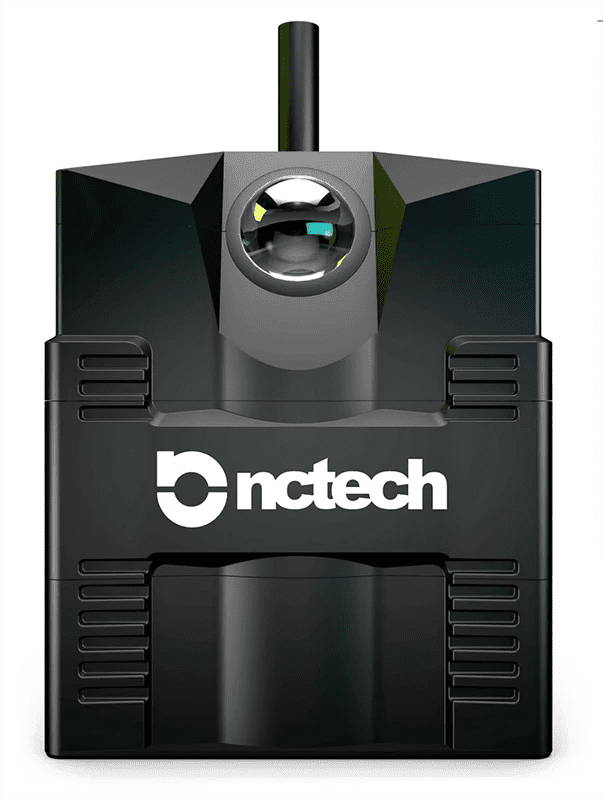
The Pros:
- 11k resolution
- 60.5MP
- Integrated IMU and GNSS sensors
- IP64
- Internal 256GB SSD
- Up to 7fps
The Cons:
- 6-axis IMU
- Vendor lock-in
- No high-precision GPS
- Apt to have issues
Conclusion:
The cameras are for HD mapping, but only partially fulfill the need for durability, reliability, and ease of operation. Its IP64 rating means that it can withstand total dust ingress but only minor water spray from any direction.
They also lack some of the deep integration requirements, such as a 360 camera array, LiDAR technology, and high-precision GPS. It also lacks on-board graphical processing units (GPUs), which would enable Edge AI applications to be run directly on the camera.
The iSTAR Pulsar also cannot process all relevant HD map data in one single unit, nor can one refresh the initially captured data. This means that maps will age and become outdated or no longer reflect real-time information.
2. Ladybug 5 Camera
Price: $15,000
The Ladybug 5, from FLIR (formerly Point Grey Research), was once the most widely used camera in the market for 360° imaging. Many of its key features, such as global shutter sensors, an accuracy level of 2 mm at 10 m, and 8K resolution, contributed to its popularity and desirability as a camera for surveying and street mapping services.
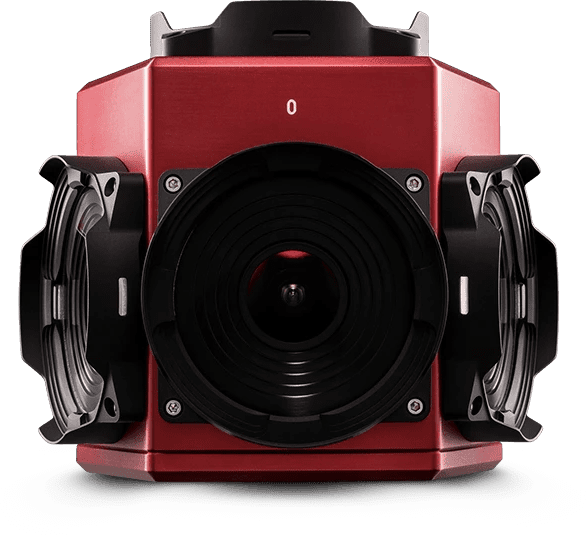
The Pros:
- 30MP
- No vendor lock-in
- IP65
- Calibrated from 2m and up
- 1 MB non-volatile memory
- Up to 14.5fps
The camera is typically a favorite because it is not vendor-locked. This allows for more versatility in use, making it ideal for governments and companies that already possess their own data-processing software system. And it also has an IP65 rating, which puts it above such cameras as the iSTAR Pulsar, in terms of durability.
The Cons:
- 6-axis IMU
- 8K Resolution
- High precision GPS
The Ladybug 5 camera is promoted as providing a wide range of functionality, allowing users to record, process, and export spherical content with ease. However, while this might have been true several years ago when it was first developed and brought to market, now the Ladybug 5 is known to be difficult to use, and the Ladybug price is considered fairly expensive due to the lack of upgrades in recent times.
The biggest and most blatant downside to the Ladybug 5 camera is the fact that, despite being one of the front-runners in the mobile mapping field, it has not been upgraded in quite some time, leaving current customers waiting.
Conclusion:
While it was once the best-in-class and popular, various competitors now surpass it in every field and specification possible. Previous and current clients of Ladybug 5 are now on the search for a new camera that will replace their outdated technology.
Check out these newer articles comparing the Mosaic camera systems to the Ladybug cameras:
What is the difference between a camera and a camera system
3. Insta360 Pro Camera
Price: € 3,999
The Insta360 Pro is one of the top solutions for cinematic VR. It grants its users the ability to film and broadcast 360-degree and 3D 360-degree images with an 8K resolution. It also possesses the capability of real-time stitching and preview.
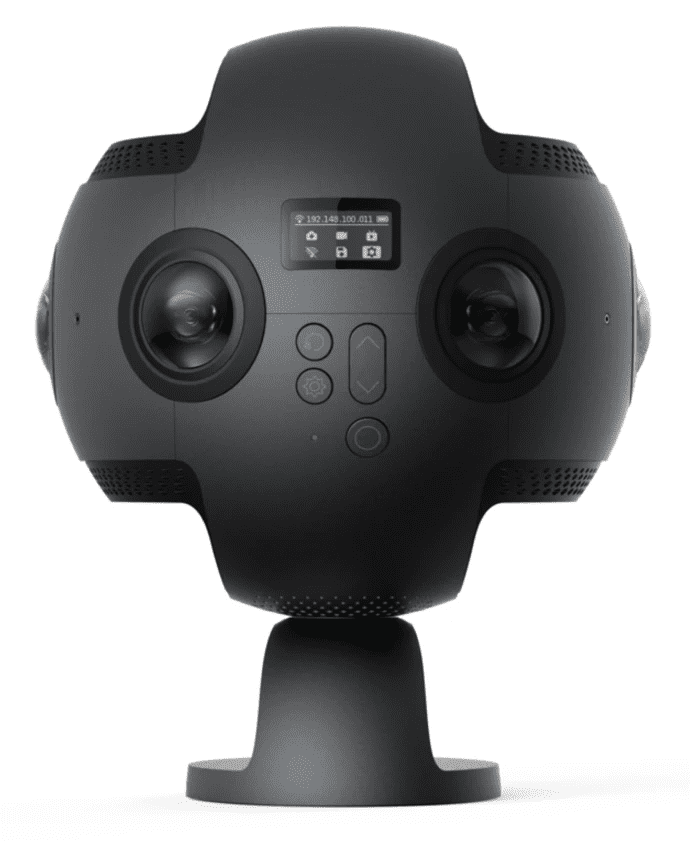
The Pros:
- Low price
- 30fps
- No vendor lock-in
- IP65
- 11K Resolution
- H.264 compression
- Real-time image stabilization
The camera’s technology enables users to quickly film, edit, and share content, such as on Google Street View.
The single biggest benefit it offers is its price. At only € 3,999, it is by far one of the most affordable cameras with 360 photo and video capabilities. However, as we will discuss, there is a reason it is so ‘cheap’.
The Cons:
- Low resolution
- No on-board GPU
- No built-in memory
- No high-precision GPS
The single biggest drawback of the Insta360 Pro is its resolution. At only 8K, it is among the bottom in its class. It also lacks many of the necessary features to make it a true 360-degree mapping camera. While it has dominated in the VR world in the last several years, its incorporation into surveying and mapping is an excellent example of ‘the wrong tool for the job.’
Conclusion:
The Insta360 Pro is much less durable than some of its competitors and does not offer the robust body frame that some of the other cameras on this list do. The 200º fisheye lenses are very prone to contact with objects in their environment, easily leading to damaged lenses; the lenses are not user-replaceable, which means that if you do have a scratched or otherwise damaged lens, you need to send the whole camera back to China for repair.
It is also a single unit for all relevant HD map data. It requires many additional hardware add-ons as well as regular updates to the external software.
4. Mosaic 51 Camera
Price: contact sales for a quote
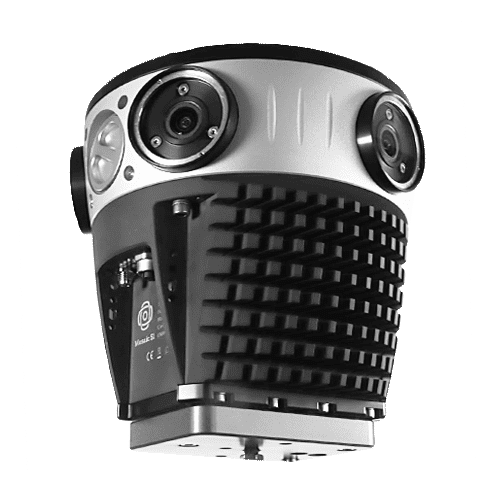
Mosaic 51 is a robust 360° camera for mobile mapping, street view, surveying, infrastructure inspection, and related 360º imaging applications such as VFX & HDR light probes for CGI backplates.
The Pros:
- Encrypted
- No vendor lock-in
- On-Board GPU
- 12K Resolution
- H.264 compression
- Connections for GNSS and IMU
The Mosaic 51 camera is a 360-degree camera that captures images with an all-in-one solution for image capture. There is no need for an additional workstation within the car, as is common with other similar cameras. Its simple frame and structure mean it easily integrates into already functioning mobile mapping systems.
Two onboard GPUs have the potential for future edge-AI to detect personally identifiable information, such as license plates and faces, which can later be blurred. This is extremely important for security and individual protection, and also makes it the only GDPR-compliant camera currently on the market.
As another added security measure, the data collected by the camera can be encrypted so that not even the driver of the vehicle can access the information if so requested by the owners. With the increasing need for privacy protection, these two features really hit the nail on the head.
The camera was created to be used for professionals, but is also capable of being used by untrained staff due to its removable, swappable storage and device and control via any web browser.
The Mosaic 51 is also the most durable camera, with an IP64 rating, meaning that it can withstand dust entering the camera, as well as having sealed and water-resistant housing and waterproof connectors. The lenses have been built so that they are easily replaceable, so that any slight scratch will not incur a completely new camera or a service by the manufacturer.
The Cons:
- Mid to upper range in pricing
- Lacks a built-in GNSS solution for millimeter accuracy
- An external battery means that the solution is not completely self-contained
The frame rate is up to 10FPS, so if you are interested in doing mobile mapping at extremely high speeds, then this camera is capable of one photo every four meters at 140km/h, which might not be enough for some applications, such as tree inspection. In this case, it will be necessary to drive more slowly. Also, there is no internal battery, which means the camera is not completely self-contained.
Conclusion:
Mosaic 51 has answered nearly all of the pain points that many organizations are experiencing when conducting mobile mapping projects. The camera has all of the ideal features regarding durability with its protected lenses and industrial connectors, precision with its internal GPS, usability with its single removable storage and easy remote control operation, and reliability with its water-resistant, long battery life. All of this translates into a camera that is the right tool for the job.
5. Cyclomedia Camera
Price: contact sales for a customized plan (data collection as a service)
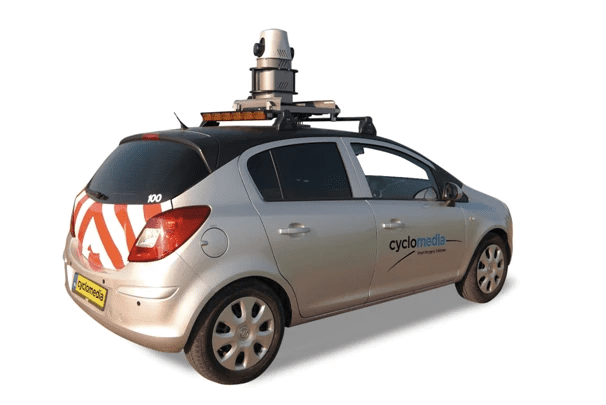
Cyclomedia is a data collection company that specializes in capturing data from the real world and translating that into insight. They use their own internal automotive fleet of 44 cars, which are equipped with their own in-house roof cameras with which they capture data for their customers, mainly in the Netherlands, but internationally as well.
The Pros:
- ArcGIS
- Street Smart API
- LiDAR point clouds
Cyclomedia cameras come equipped with a LiDAR scanner, making it capable of 360° spherical high-resolution panoramic images, which are geometrically accurate.
The results from their services are extremely advanced and of the highest quality, and among the most accurate and thorough coverage.
Following data capture, Cyclomedia also performs data visualization and data insight, resulting in such outputs as the identification of lamp posts, traffic lights, traffic signs, road markings, trees, and manhole covers. Such agencies as tax offices and insurance companies have benefited greatly from this information.
The Cons:
- No hardware offered
- Limited by the car fleet
- Vendor lock-in
This service is generally well-received by its customers and is a nice, neat package for those clients who possess the funds for such a service. However, due to their limited number of equipped vehicles, there is the issue of efficiency and logistics as the company is primarily situated in the Netherlands. These circumstances do not make it particularly easy for companies or governmental organizations to acquire the cameras or operate them as per their needs. Rather, they are tied to the availability of the automobiles and any time restraints from other bookings of the cars.
Conclusion:
For companies or governments that are looking to conduct a brief but highly precise mapping of a particular area, they will not regret using Cyclomedia. They deliver some of the best data and data insights out there. Their work is a cut above the rest for those who can afford the service and who do not need regular updates or real-time images of the space in question.
6. Mosaic X Camera
Price: contact sales for pricing
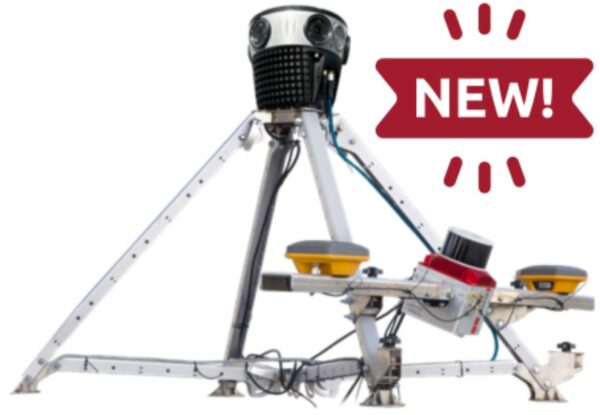
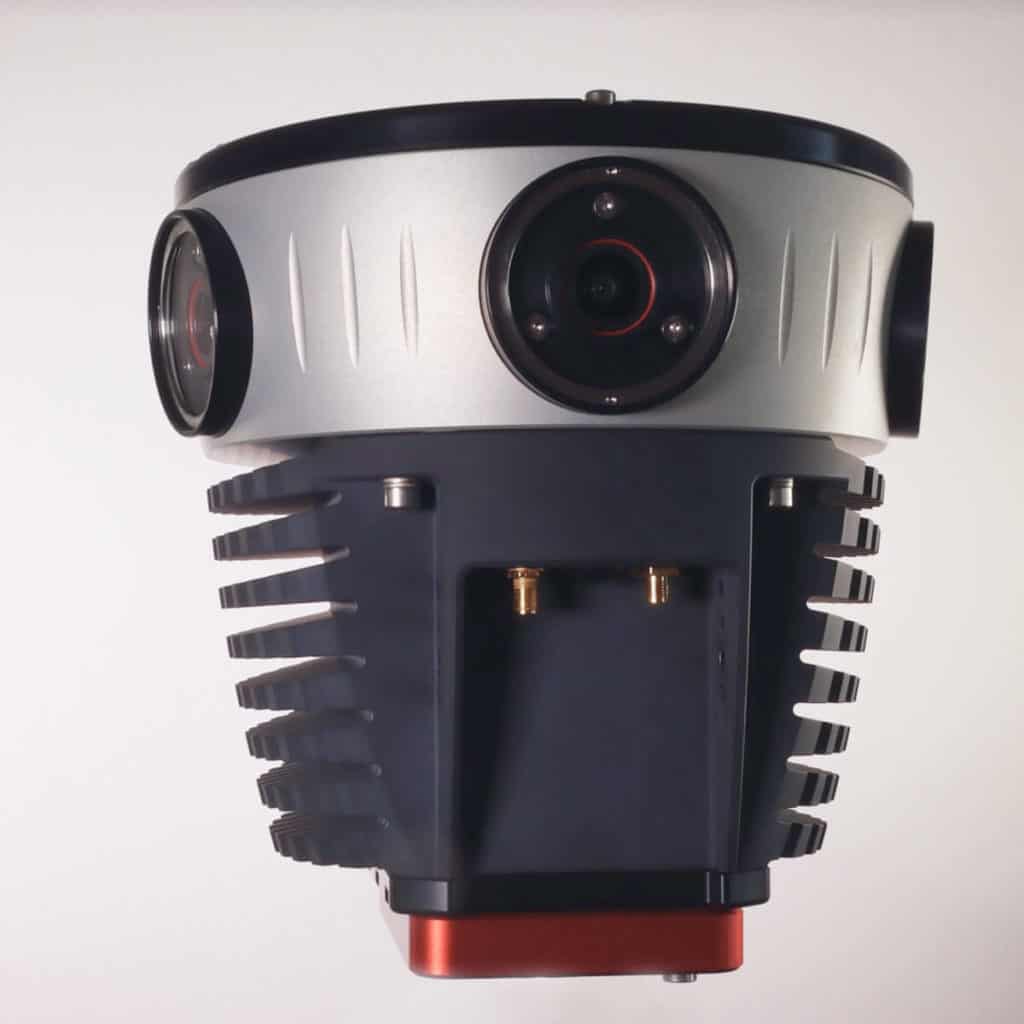
As mentioned in the intro, the Mosaic X is the newest mobile mapping system from Mosaic. It is quite similar to the Mosaic 51 – 6 lenses for 360-degree image capture, on-board CPU and GPU for huge AI potential. Let’s take a closer look below as to why this might be the game-changer in mobile mapping cameras.
The Pros:
- Global shutter
- All-in-one solution
- 6x13MP image sensors
- Robust frame and replaceable lens covers
- Non-vendor locked
The decision to make the change from rolling shutter to global shutter in the construction of the Mosaic X means that this camera is now an ideal candidate for photogrammetry, 3D modeling, and traditional mapping.
The all-in-one solution comes ready for the road. Its robust frame, IP64 rating, industrial-grade waterproof connectors, and passive cooling mean it operates in even extreme conditions and climates. There is no need for a computer on board the vehicle. It comes equipped with a removable USB drive up to 2 Terabytes of storage, which allows for a full day of smooth data capture.
The Cons:
- Post-processing software not provided
- Car-mount not provided (but drawings are)
- Lacks mm-level accuracy
Unlike some of its competitors, the Mosaic X (much like the Mosaic 51) is a very barebones system with no additional trinkets – no car mount, no post-processing software. This was purposely done to allow users to incorporate the system into any of their larger bespoke systems, as well as allow those newer to surveying, to have a solution that is easy to manage and not cumbersome.
Conclusion:
The Mosaic X is the only all-in-one 360° solution for mobile mapping with a global shutter. This makes it very unique in this field. It is much more versatile and nimble than many of the other larger systems, which require an entire workstation on board and an operator to manage the data capture. The fact that the Mosaic X is able to capture street-level data at highway speeds and is still a single unit means it is ideal for scaling mobile mapping solutions, such as surveying businesses with multiple cars in their fleets.
Competitive Matrix for the Best 360º Mobile Mapping Cameras
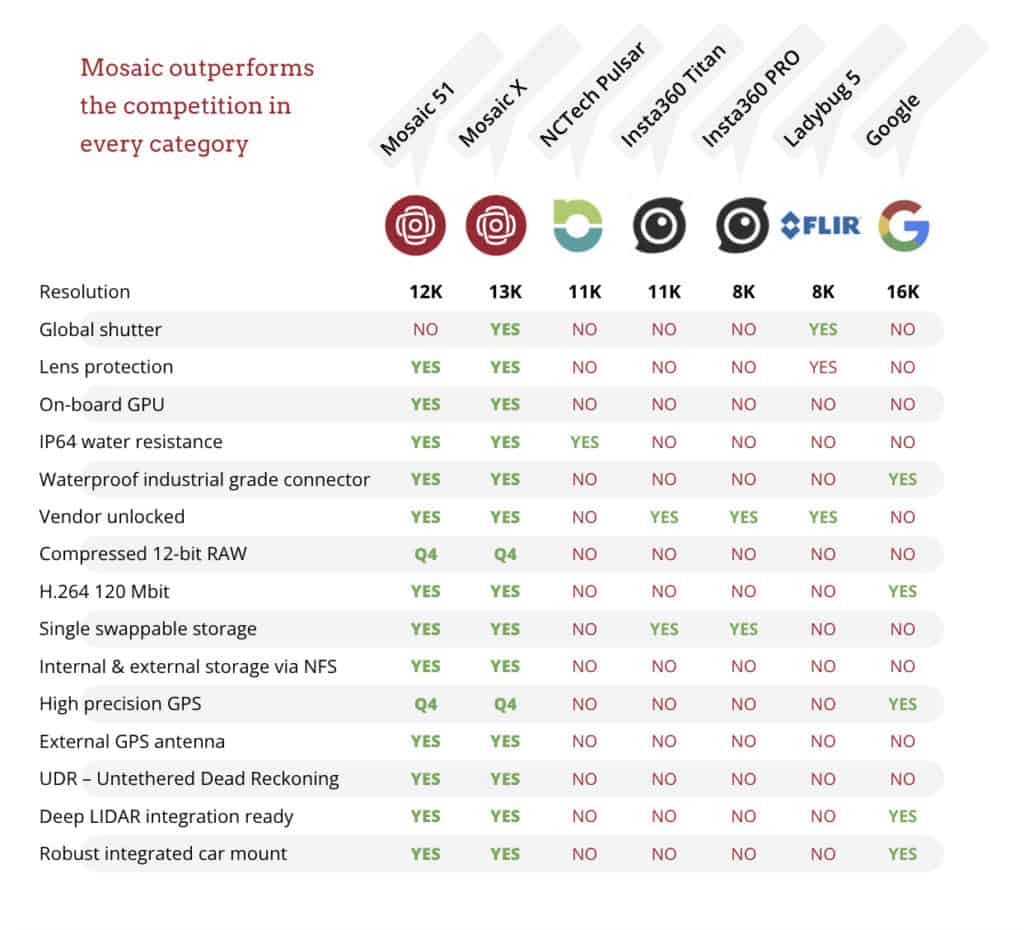
Taking into account the necessary features that make a durable, user-friendly, and precise mapping camera – one which is built specifically for the very intention of mobile mapping, there is one clear winner.
2022 winner for best mobile mapping camera: the Mosaic X
The Mosaic X is the breakout star in the field this year. Improving on the Mosaic 51’s success and recognition as the solution for those in the market for a 360-degree mobile mapping camera, the Mosaic X brings home the award for 2022.
It is a rugged, robust mobile mapping camera solution that allows an individual – expert or not – to deploy, operate, and capture images for an entire day – easily, quickly, and reliably.
It also contains deep integration of camera data feeds such as 360 camera array, LiDAR, and high-precision GPS. The modularity of the design allows for an initial capture followed by a refresh of data to keep maps as real-time as possible.
It allows any company, any government, or any individual to buy a camera and start recording 360-degree images at the highest quality, with ease, and with the least amount of hardware, software, or problems.
So, whether you are looking to map your town, city, or country and are in need of the best camera for mobile mapping, be sure to contact Mosaic to find out how you can find the solution to your needs.