Make your mobile mapping system work for you – not the other way around! That’s what these customers did with popular external sensors from EMLID, Xsens, RIEGL, Leica, Trimble, and more.
As the usefulness of geospatial data continues to increase, the ability to streamline data acquisition across multiple sensor platforms is more essential than ever.
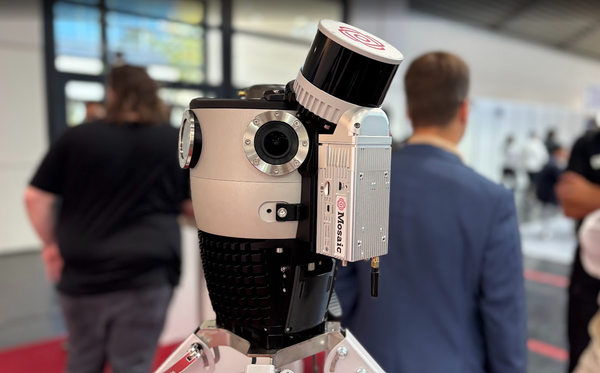
Mosaic’s mobile mapping cameras are specifically designed to capture high-resolution 360° images and integrate with external sensors, including GNSS receivers, LiDAR scanners, and INS/IMU units. This modular approach allows you to tailor your team’s equipment setup for enhanced data accuracy and comprehensive spatial analysis.
Whether you’re attaching a single sensor or setting up an entire data capture ecosystem, Mosaic 360° cameras offer the flexibility to get the job done.
Follow along to discover our favorite integrations with external sensors from across the geospatial industry.
Out-of-the-box integrations
For these integrations, our team can provide detailed documentation and any additional equipment you may need to fully integrate your Mosaic camera.
EMLID Reach RS2/RS2+/RS3
This robust, multi-band RTK GNSS receiver is ideal for surveying in challenging conditions, especially when paired with Mosaic cameras, which are IP67-tested.
This was the first third-party integration Mosaic’s team of engineers developed. It has quickly become one of the most popular integrations over the last three years, with many integrated systems running across North America and Europe.
You can also read more about the EMLID RS2 and Mosaic integration here.

XVN (Xsens Vision Navigator)
Movella’s XVN was also fully integrated with Mosaic cameras to boost GNSS capabilities using RTK. Achieve centimeter-level accuracy with orientation information for high precision, all without the need for additional post-processing, as it is an automatic part of the stitching process. Enhance your precision and efficiency in mapping and 3D reconstruction with XVN.

Partner integrations
If you’re interested in a partner integration, you may need to work directly with the vendor to connect your Mosaic cameras.
RIEGL V-Line Scanners
RIEGL’s line of V-Line Scanners is among the most widely recognized mobile laser scan systems on the market. Pair the accuracy of V-Line Scanners with the Mosaic X’s high-resolution 360° imagery for quality outputs you won’t find anywhere else.
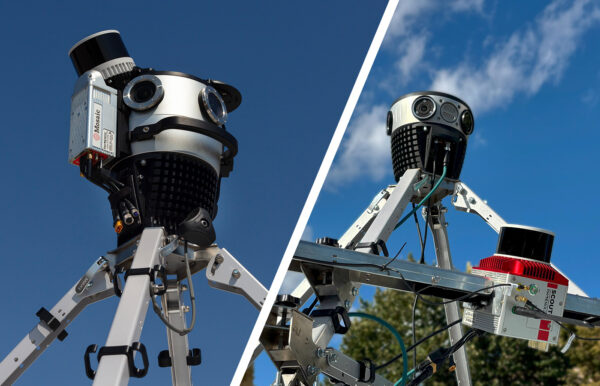
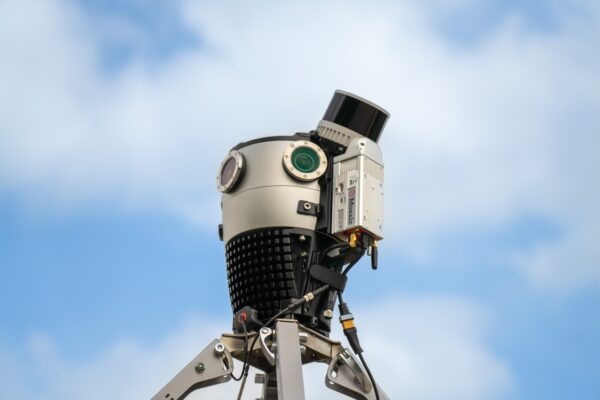
Kavel 10 needed a compact system to help colorize point clouds, but the camera would need internal storage and a web interface that didn’t require an external computer or excessive cabling. The Mosaic X combined with a custom setup that included a 3D laser mapping system, a RIEGL VUX Scanner, an IGI FOG IMU, GPS, and other software elements.

Leica Pegasus TRK
Achieve centimeter-level accuracy (with the optional RTK) with the Mosaic X and Leica Pegasus TRK. These devices seamlessly integrate to upgrade your mobile mapping experience.
For WGI, the Mosaic X’s high-resolution imagery combined with the Leica Pegasus TRK allowed them to “extract linework and points from the point cloud with finer detail than we could have achieved in the past,” especially for texturizing their 3D models. You can read more about their successful camera and LiDAR integration here.

Trimble MX9
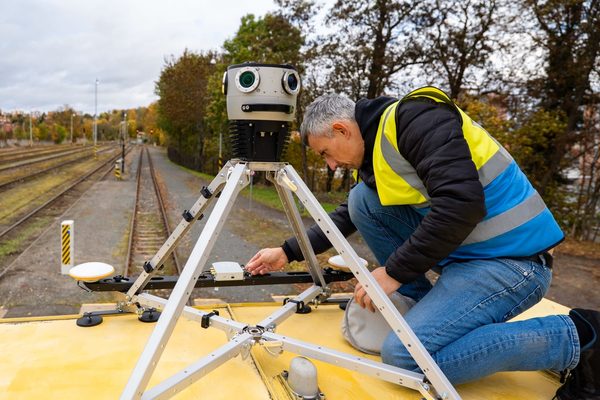
Integrate the Mosaic X with the Trimble MX9 for top-notch synchronization and triggering, particularly in large-scale railway mapping projects. This duo provides high-quality imagery alongside precise positioning data (with the optional RTK).
For Space42, this solution was the obvious choice. Their integration involved creating a synchronization cable that enabled the MX9 system to trigger the Mosaic X camera. As a result, both devices operate on a shared timestamp. This allows the Trimble trajectory to be used for accurate georeferencing of the panoramic imagery captured by the Mosaic X.
Imagine upgrading your mobile mapping camera without having to invest in an entirely new system. This is the kind of cost savings that you can deliver back to your clients, or invest in other areas of business.

Customer integrations
Field Group and Zoller+Fröhlich (Z+F)
For Field Group, a higher-resolution camera that could stand up to Norway’s tough climate and integrate with their existing geospatial surveying equipment was a must. Their current Ladybug5 did not deliver the quality their clients needed.
Integrating Zoller+Fröhlich’s (Z+F) LiDAR, GNSS, and IMU with a Mosaic X camera cut the data collection time for Field Group from 6 months down to just 10 days for 2,800 km of railway tracks.

Dymaxion’s custom integration
Requiring your team to retrain on a vendor’s proprietary workflow, specific software, and/or hardware ecosystem wastes time and money. It limits your integration flexibility, complicates post-processing, and often results in time-consuming or costly workarounds.
Mosaic eliminates these bottlenecks by removing vendor lock-in and prioritizing open formats and universal connectivity. Say yes to more projects with a flexible setup that works for you!
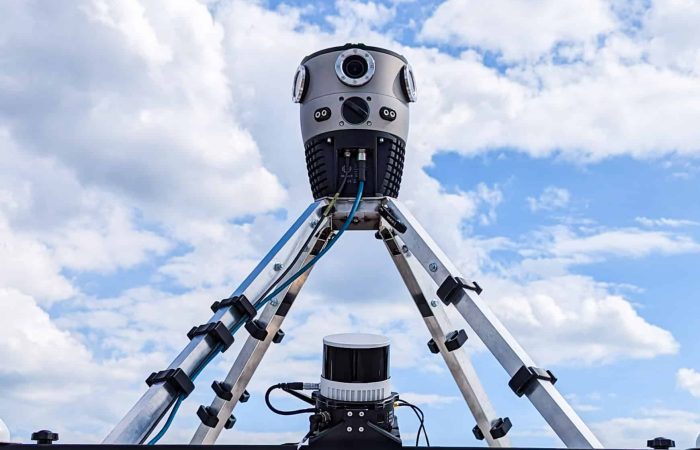
This was the case for Dymaxion, an engineering company based in Colombia. When a large-scale project came across their desk, they needed to a camera they could build around a LiDAR system without clunky workarounds. The Mosaic 51 integrated into their custom setup, and they were able to take on large-scale and more detailed projects with ease.

ARX’s upgraded visuals
For our Brazilian partner, ARX, the Mosaic 51 camera was the flexible, turn-key solution for their existing mobile mapping system. They already invested in other hardware, but needed to upgrade from the Ladybug5 to a higher-resolution camera without replacing the entire system.

Why integration matters in geospatial workflows
Universal connectivity and sensor-agnostic design make Mosaic 360° cameras a reliable choice for integrating into your existing workflow because precise geolocation, context-rich visual data, and spatial geometry are rarely captured with a single device.
From corridor mapping to urban infrastructure inspection, survey-grade results rely on synchronizing multiple datasets. These range from high-resolution imagery and positional data to inertial measurements and LiDAR.
Yet, achieving complete sensor harmony often requires expensive, restrictive, and proprietary ecosystems or vendor-locked solutions. Mosaic addresses this industry-wide challenge with a truly open and flexible hardware approach.
For mobile mapping teams to meet industry requirements across engineering, infrastructure, and urban planning, they must merge:
- High-resolution panoramic imagery,
- GNSS-based geolocation,
- INS/IMU-based orientation and motion tracking, and
- LiDAR-derived surface geometry.
In one joint proof of concept with SmartDelta, Mosaic tested the camera’s ability to integrate with multiple external sensors from different brands. They included the Applanix LVX GPS/INS, Xenics Gobi 640 Thermal Camera, Ouster LiDAR, and Hesai LiDAR. The results of the integration were synchronized data with precise timestamps and georeferencing.

Is your integration next?
Are you tired of settling for “good enough” when it comes to mobile mapping? Our team is here to help you find the appropriate integration to fit your project’s needs. Reach out today to learn more about our other success stories and how you can become one, too.